Reporter: Audra Grigus | Interview translation: Nicha Wachpanich
Date written: April 20, 2020
Phuket, Thailand— Circling the edges of the enclosure, tip jars in hand, the crocodile trainers of Phuket Zoo hunt for the money of enthused tourists. After spending 15 minutes putting their heads in the mouths of crocodiles, sitting on them, and pulling them around their watery enclosure, the trainers are approached by a man with a request: to have his photo taken with a crocodile. The man is welcomed into the enclosure and ushered over to one of the crocodiles to sit on. With a big smile and a thumbs up from the tourist, his son takes his picture from behind the glass. Before leaving, he pulls out his wallet and gives the unconcerned trainers their pay.
Until COVID-19 shut down animal parks across Thailand, crocodiles were one of the few animals at the Phuket Zoo that did not serve the purpose of being used as a photo opportunity, but the growing need from tourists to get the perfect picture made it happen. However, Phuket Zoo will not be reopening after COVID-19 and the animals will be handed off to other zoos when it is safe to do so.
Other animals that were used at the zoo for photo opportunities were birds, monkeys, elephants, and tigers
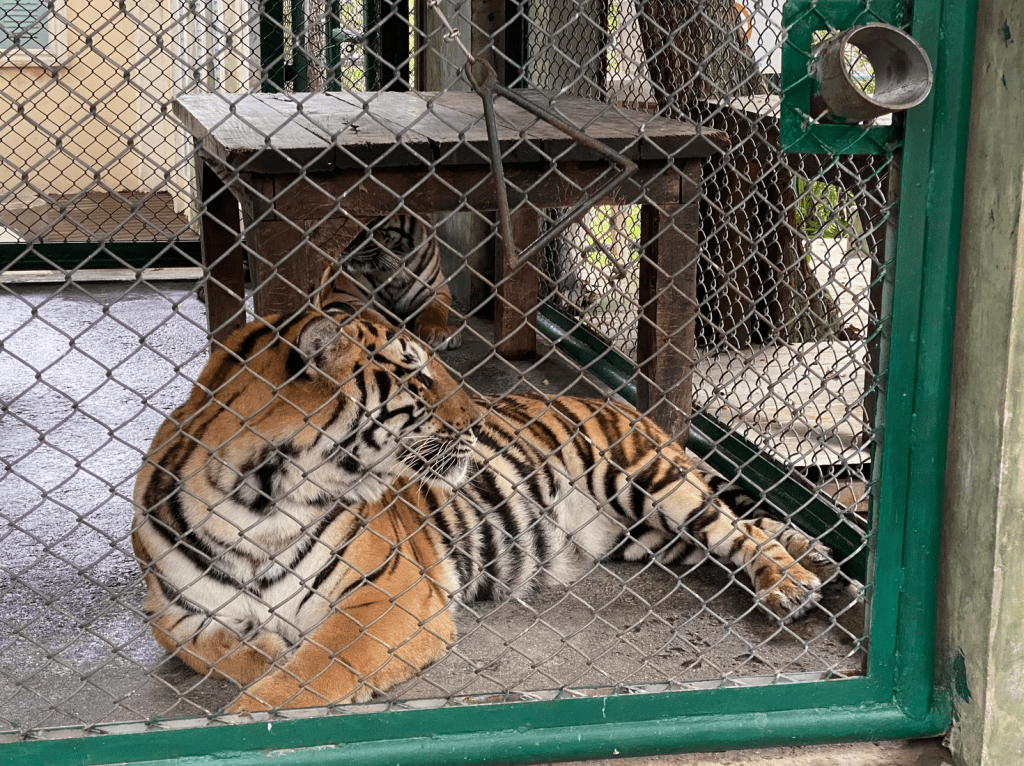
Photo | Audra Grigus
Tigers of tourist hotspot Tiger Kingdom in Phuket, Thailand, lay around in their cage while taking a break from being photographed.
“Not many places in the world can you go and get in a cage with a tiger and take a picture, or sit on the back of an elephant, or have a bird on your shoulder or have an orangutan sit next to you,” said President of the Love Wildlife Foundation Nancy Gibson. “People, I think, want to be up close and personal with wildlife because it looks cool. Sometimes people forget to look at the mistreatment behind it.”
Tigers are a common tourist attraction in the southern region of Thailand. At locations such as Tiger Kingdom, the new Tiger Park, and formerly Phuket Zoo, visitors are able to interact with the tigers and get their pictures taken with them.
Prices for tiger attractions like these vary based on the size of the tiger. At Tiger Kingdom, photos with the smallest, youngest tigers cost 1,300 baht; the small, old tigers and the medium tigers cost 900 baht, and big tigers cost 1,000 baht. 3,700 baht (~$43 USD) being the most expensive package in which visitors get to see all four sizes of tiger.
“Unfortunately, social media has had a large part to play as the images of selfies has been easily spread making others want to join in and get a photo too,” said Co-founder and Director of For Tigers Tanya Erzinclioglu said. “It hasn’t helped that a number of high profile celebrities have also joined in and have photos with tigers and other wildlife, publicly documenting the experience focusing on their own enjoyment rather than on the welfare issues at hand.”
Instagram has attempted to curb wildlife tourism by adding warnings to certain hashtags such as ‘Tiger Kingdom’, but this does not stop people from viewing the harmful photos.
To assess the welfare of the tigers being held in captivity, Erzinclioglu’s For Tigers 2019 research focuses on the Five Domains: 1. Nutrition; 2. Environment; 3. Physical Health; 4. Behaviour; 5. Mental State.
“Unfortunately, the majority of zoo-housed tigers do not live in good conditions,” said Erzinclioglu. “They are generally living in concrete-floored cages with little or no access to a natural environment or with any kind of enrichment to stimulate natural behaviors.”
Speed breeding and inbreeding are methods used to keep up with tourist demand of the animals. Inbreeding amongst tigers results in white, golden, or snow tigers, crossed eyes, or any other sort of physical deformity.
“It might be cliche, but the slogan, ‘a second for you, a lifetime for them’, is very pertinent to this situation,” Erzinclioglu said. “Many people think that having a photo is ok, because it’s just a one off. But it isn’t one off for the tiger, it happens hundreds of times in their life.”
A Close up to Cruelty report by World Animal Protection revealed that Thailand is the third highest tourist destination for wildlife selfie photography in the world, after Australia and the United States. Between 2014 and 2018, the popularity of wildlife photography increased by 292%.
Wildlife tourism has proven to be profitable to a point that has inspired illegal forms of this tourism. One animal that can be often found on the beaches of Karon and Kata for illegal transactions are the slow lorises.
A slow loris is a small, nocturnal, omnivorous primate that is known for being photogenic and “cute”. Since 2007, the slow loris has been protected from commercial international trade under Appendix I of CITES (the Convention on International Trade in Endangered Specifics of Wild Fauna and Flora), but they are easy targets as they are slow, nocturnal and will not try to escape during the day. However, the animals have a venomous bite and illegal handlers defang them for safety reasons.
Last year there were 10 reported cases of illegal slow loris tourism, while this year there have been none reported. The local vendors on Karon and Kata beach have not seen illegal slow lorises handling since the new year.
Suthin Kaewprachum, ranger at the Khao Phra Thaeo National Park, believes that it’s one gang that organizes this business. It started becoming a problem about 15 years ago, around 2005-2006.
“They use two people, one on a motorcycle to watch out and one to offer photos at the beach. When the officers go down, they will send a signal, call to the other guy so he can run away,” Suthin said.
The same criminals have been doing this for years and are now easily identifiable for police. When the rangers go undercover to stop the illegal slow loris exploitation, they also face the challenge of being identifiable, being Thai makes them stand out amongst the tourists.
“They aren’t Phuket people who do this, they are outsiders. Mostly from Isan, because Phuket people have their own businesses and careers. Phuket now has more non-phuket residents living here than Phuket people,” said General Administrative Officer at the Khao Phra Thaeo Non-Hunting Area Naruemon Ninlaphant.
At night, while the mother is going out to look for food, the babies will remain in the trees, making them easier for the taking.
“They are being sold on Facebook, Instagram, and online,” Gibson said. “Everything has gone online now. The photo prop thing has gone down because of the law enforcement. But selling is still there.”
Tourists will sometimes buy the slow lorises being used for these illegal operations in an attempt to rescue the animal.
“They are actually doing the same thing as if they were buying it as a pet,” Gibson said. “The traders don’t care where their source of money is from. All they care about is that they are getting money, your purpose doesn’t matter. Tell somebody, get it confiscated, it’s better than buying them.”
The best action that can be taken when seeing illegal activity is to call the Department of National Parks hotline 1362.
“I would say that if it’s for wildlife tourism in general, don’t participate,” Gibson said. “The more you’re supporting it, the more it happens. At some point these animals are not going to be here anymore.
Click here for Nicha Wachpanich’s version for Green News (in Thai, no English translation).
 AUDRA GRIGUS